
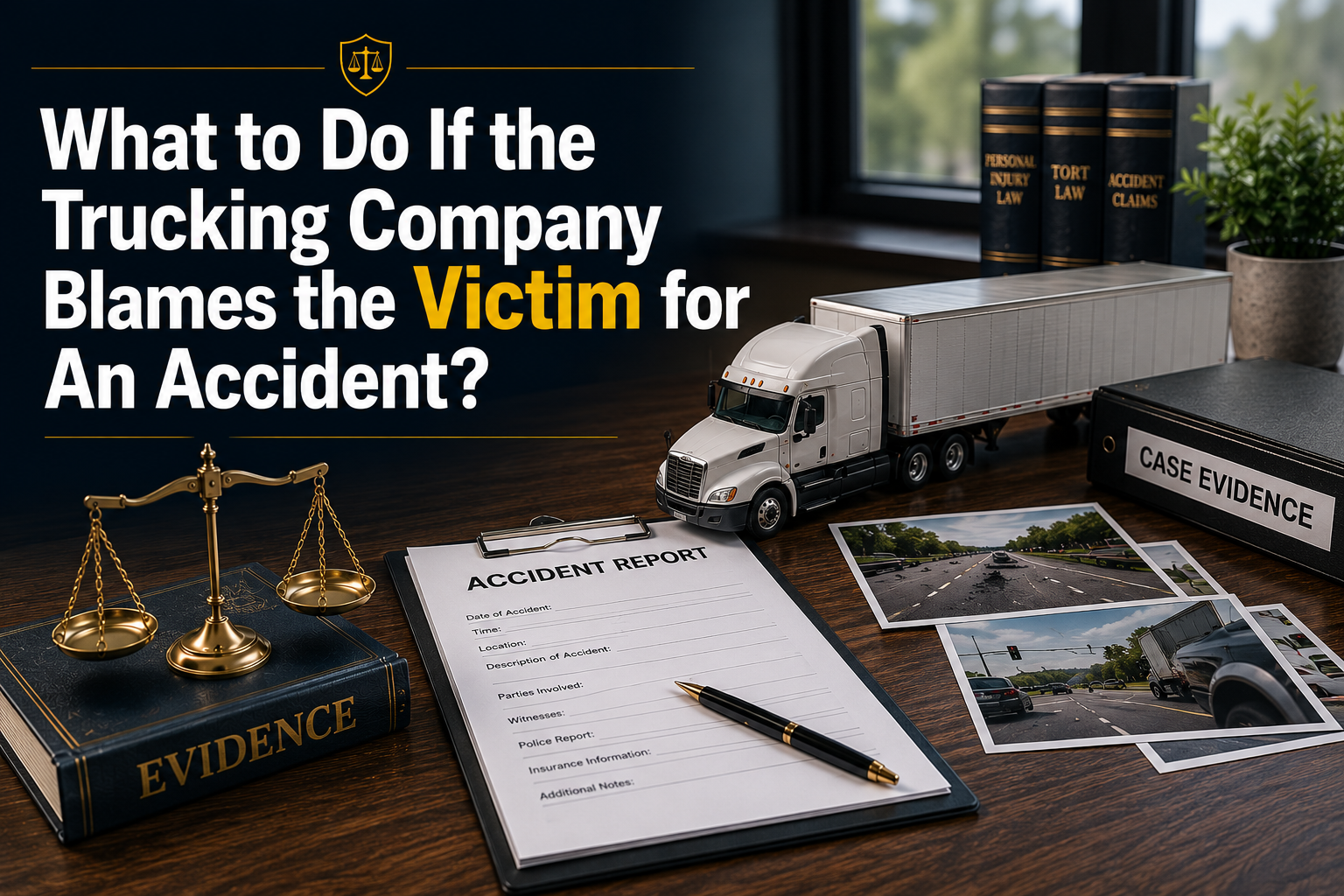
After being hit in a truck accident, the victim has to deal with medical bills, lack of income, constant physical pain, mental trauma, financial crunch, and others. The post-accident scenario overwhelms the victim. The situation worsens when the trucking company joins in and claims the accident was the victim’s fault.
It’s important to know that being blamed by a trucking company doesn’t mean the victim is legally responsible. The claim must be proven with evidence. Understanding personal injury rights under current Florida law and taking quick action to protect your rights can make the difference between full compensation and a compromised settlement. Here, the victim must consult a truck accident attorney in Orlando.
Why Do Trucking Companies Blame the Victim?
After a serious crash, trucking companies often attempt to shift blame onto victims to protect the company’s finances. Adjusters may blame the victim for unsafe lane changes, tailgating, speeding, or distractions. They scrutinize victims’ recorded statements and social media for useful information and may offer a quick, low settlement before the victim consults an attorney. This tactic has become more powerful since Florida’s 2023 tort reform, giving insurers an even stronger incentive to push blame onto victims.
According to Florida Law, the Victim Still Has a Valid Claim
Florida’s HB 837 (signed March 24, 2023) changed the state’s negligence standard from pure comparative negligence to modified comparative negligence, codified under Florida Statute §768.81:
- If the victim is found 50% or less at fault, the victim can still recover. Only the settlement amount gets reduced. (Example: 25% at fault on $200,000 in damages = $150,000 recovery.)
- If the victim is found more than 50% at fault, s/he is barred from recovery entirely.
An attorney presents unique evidence of the truck’s fault before the other side’s narrative becomes more powerful.
In addition, under Florida Statute §95.11(4)(a), the timeline to file personal injury claims in Orlando has been reduced to 2 years from 4 years as of March 24th, 2023.
Evidence That Shows the Truth
Whichever party collects the evidence first in a truck accident case is most likely to determine the outcome. An experienced truck accident attorney in Orlando collects and preserves the following immediately:
- Electronic Logging Devices (ELD) – devices mandated by the FMCSA track how long the truck has been driven, how long the truck has rested, and the truck’s speed. These show whether the truck driver violated the “hours of service” rules or was fatigued while driving.
- Black Box / Event Data Recorder (EDR) – black box captures pre-crash speed, braking, steering, and engine performance, which directly contradicts the trucking company’s account.
- Driver Qualification Files & HOS Logs – Required under 49 CFR Part 395; the logs reveal a history of safety violations or a company culture of pushing drivers past legal limits.
- Maintenance and Inspection Records – Brake failures, tire blowouts, or lighting issues are often found to be neglected maintenance.
- Dashcam and Surveillance Footage – From the truck’s cameras, nearby businesses, or traffic systems, footage can be overwritten quickly if not secured fast.
When an attorney takes the victim’s case, one of the first steps is to issue a spoliation letter demanding the preservation of all accident evidence.
Mistakes to Avoid When Blamed
- Not Accepting A Quick Settlement: The victim does not accept a quick settlement offer because these offers are typically less than the settlement value the victim deserves. Anyone who signs a release after accepting a quick settlement offer can never seek additional compensation for their injuries later.
- Inconsistent Statement: The trucking company’s insurance adjusters attempt to obtain an admission of fault or to get the victim to say something inconsistent with what the victim says later. The victim does not have to give a recorded statement before speaking with a personal injury lawyer in Orlando.
- Delayed Medical Treatment: It’s advised not to delay medical care or miss treatment appointments. When the victim doesn’t follow up regularly with doctors, defense lawyers will use those gaps in treatment history to argue that the injuries were not serious and/or were not caused by the accident.
- Discussing the Accident in public: The victim should not discuss the accident or their injuries on social media. Even if the post is taken out of context, defense lawyers may attempt to use it against the victim and argue that the victim is not as badly injured as the victim claims to be.
More than One Party May be Liable
Depending on the accident, the victim may have more than one source of liability for their truck accident damages. Potentially liable parties could include:
- The trucking company: liability can be established through the principle of respondeat superior for the driver’s actions, or directly due to negligent hiring, lack of proper training, and/or safety violations in attempts to meet deadlines.
- Third-party cargo loaders – improper loading or unsecured cargo may contribute to the crash.
- Manufacturers – in cases involving defective trucks or components.
- Maintenance contractors – a mechanical failure traceable to their work may cause or worsen the crash.
Under Florida’s pure comparative negligence system §768.81(3), each defendant is liable only for their proportionate share of fault, making it essential to identify every liable party.
We Fight Back for Your Personal Injury Rights
Each time a victim files a truck accident claim, the victim is struggling with pain, financial burden, and uncertainty. Our attorneys bring the resources and courtroom tactics needed to successfully fight the trucking company and/or its insurer.
We act immediately on issuing spoliation letters, retaining accident reconstruction experts, reviewing FMCSA compliance records, and building the liability case. Our truck accident attorney at Injury Assistance Law Firm handles everything from investigation through negotiation and trial so the victim can focus on recovery.
We handle personal injury cases on a contingency fee basis. The victim pays no attorney’s fees unless we win.

Comments are closed.